

Over the last few years, precious metals – especially gold – have regained relevance in global finance. Once dismissed by some as an outdated relic of archaic systems, gold is again commanding serious attention. Recent price action has garnered the eye of investors and major money managers, many of whom are revisiting the asset class for the first time in years. This makes it timely for us to re-examine how gold’s rise interacts with the U.S. dollar and global currency markets, and to discuss potential effects on broader economies and markets. It might seem “boring” at first, but beneath the surface its implications for investors could be profound.
GOLD’S GOLDEN RUN
Consider this:
- In late 2022, gold was trading near $1,800 per troy ounce
- By the end of 2023 it approached $1,940
- By December 2024 it was roughly $2,386
- At the time of this writing (9/30/25), gold is worth $3,898 per ounce!1
In less than three years, gold has more than doubled in value – a notable move for any commodity. With sustained demand, not only from speculators, but more importantly from institutional players such as central banks, large money managers and sovereign reserve administrators, it is our opinion that gold’s rise does not appear to be a short-term tactical trade. In the first quarter of 2025, for example, the National Bank of Poland increased its holdings significantly, and China resumed steady reported purchases.2 At a broader level, global central bank gold reserves, according to the World Gold Council, have reached record levels – pushing upward of 36,700 tonnes, surpassing levels not seen since the post‑Bretton Woods era, the modern era of fiat currencies.3
We see the drivers clearly: mounting fiscal debt burdens, questions over monetary policy credibility, fears of inflation, continued increase of money supplies, and a growing desire among many nations to lessen dollar dependence – or at least limit exposure to U.S. Treasuries. Gold is no longer a relic held in mom and pop’s safe; it is reasserting itself as a cornerstone of strategic reserve policy.
GOLD & GREEN – METALS AND THE DOLLAR
When gold climbs, it tends to cast a shadow on the U.S. dollar. Gold is priced in dollars, so if the dollar weakens, a rising gold price is easier to absorb. But more than that, the upward trend in gold ,may reflect investors’ declining confidence in fiat currencies – especially the dollar’s role as the world’s reserve currency. History suggests a negative correlation, especially over tail events, between gold and USD exchange rates. In times of stress or uncertainty, gold exhibits safe‑haven behavior in its relationship to currencies.4 In more normal periods, gold can act as a hedge or diversifier in currency portfolios. One common rule of thumb is that a sharp gold rally – say, +10% over a given period – often correlates with a 2–3% weakening of the dollar, as measured by the DXY index (FinanceMarketsToday.com).5 Essentially, when investors are reallocating out of dollar-based assets and into gold, downward pressure is exerted on the dollar.
As Confidence in the Dollar Weakens, Gold Prices Rise
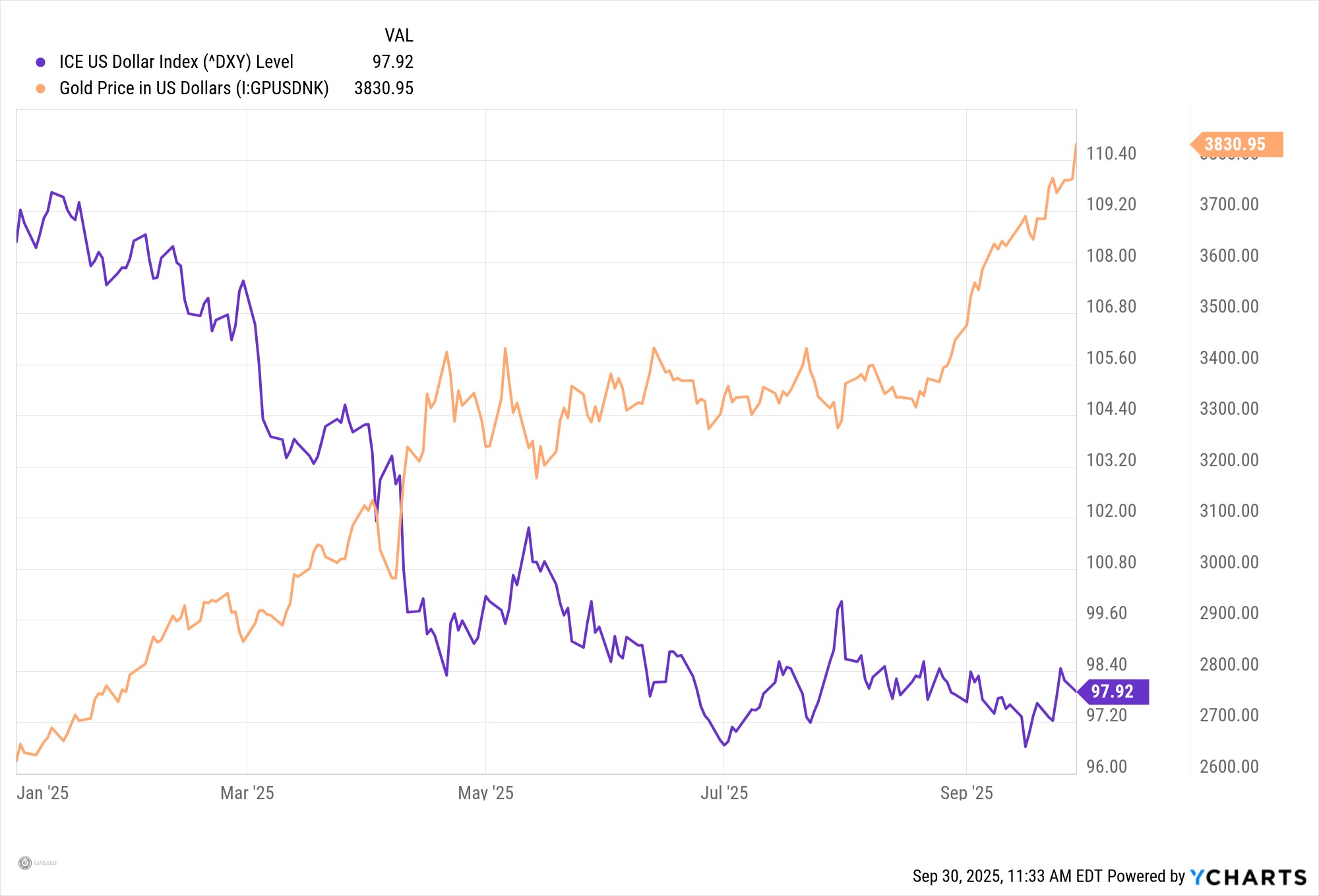
The dollar’s strength or weakness is shaped not only by gold but also by interest rate differentials, macro data, central bank policies, and geopolitical confidence. For example, when the Federal Reserve cuts the overnight lending target, real yields may fall, making the dollar less attractive and giving gold more room to advance. We’ve seen hints of this recently with U.S. inflation data coming in softer than expected, labor markets weakening, and futures markets increasingly pricing in more additional rate cuts for 2025 and into 2026.6
Gold’s upward momentum feeds directly back into the psychology of currency markets. A persistent rally can encourage currency traders to reprice future USD weakens, prompting capital to shift from dollar‑dominated liabilities into assets such as gold or non‑USD reserve assets. In this way, gold becomes more of an active market signal rather than just a passive recipient of dollar moves.5
Gold and the greenback often move in a feedback loop: dollar weakness leads to gold strengthening, which in turn leads to greater doubts about the dollar, reinforcing the cycle until interrupted by some pivot or external shock.
CURRENCY MOVEMENTS, GLOBAL MARKETS AND ECONOMIC CONSEQUENCES
When gold exerts downward pressure on the dollar, multiple effects ripple across global currencies.
- First, non‑U.S. currencies relative to the dollar tend to appreciate. The euro, yen, pound, and others often benefit as capital flows out of the dollar. We have seen this dynamic play out clearly this year. Stronger foreign currencies can tighten trade balances, as imports become cheaper for non-USD buyers, but it can also create headwinds for export competitiveness. If domestic demand is soft, this can add deflationary pressure.
- Second, “commodity currencies,” such as the Australian dollar, Canadian dollar, South African rand, etc., often benefit from higher gold and commodity prices. These nations are direct producers of precious metals, so rising metal prices boost export revenues, strengthen trade balances, and support currency appreciation. The currency of a gold‑producing country tends to pick up a tailwind as gold revenue inflows rise. Conversely, when gold weakens, pressure returns.5
- Third, emerging market currencies can feel the squeeze in a gold‑driven dollar decline scenario, as many emerging markets issue debt in U.S. dollars. If the dollar weakens, their debt-servicing burden loosens somewhat in terms of local currency; but if capital pulls back in anticipation of U.S. or developed-market volatility, their currencies may still come under downward pressure anyway. Simply put, a gold rally can prompt investors to rebalance capital away from riskier markets, punishing their currencies unless they are perceived as safe.
- Fourth, these currency shifts feed through into global trade patterns and capital flows. A stronger non‑USD currency gives those countries more strength to import, spend, invest, and accumulate reserves. In turn, countries consider reserve diversification strategies — including gold, euro, yuan, etc. The rising interest in “de‑dollarization” is no longer just small talk, according to CNBC – it is being established in reserve shifts and trade arrangements outside dollar transactions.7
- Lastly, the cumulative effect of currency and capital flows tends to amplify global divergence. Countries with structural strengths such as low debt, commodity endowments, and credible monetary policy tend to benefit while risks such as twin deficits and foreign liabilities are exposed. In such cases, precious metals may act like a seismograph, signaling stress points in the global system.
WHEN SHINY GETS SERIOUS
Precious metals, especially gold and silver, have been signaling loudly from the rooftops for the past three years as evidenced by the price appreciation. Even alongside an appreciating U.S. equity market, the “safe haven” assets have been sharing their own stories of deep undercurrents in global macroeconomics, reserve management, and currency strategy. Their climb exerts pressure on the U.S. dollar, reshapes exchange rate dynamics, and recalibrates capital flows, trade balances, and financial portfolios worldwide. For investors, the impact is seen in inflation expectations, borrowing costs — and arguably most importantly — investment returns.
Our opinion is we are witnessing a renaissance for precious metals – not as nostalgic relics, but as active mediators in 21st‑century monetary dynamics. Following the aftermath of COVID-induced monetary and fiscal policies, the relationship between gold and fiat currencies has entered new phase, one in which precious metals carry meaning far beyond their shine.
SOURCES:
- YCharts – Gold Price in US Dollars
- World Gold Council – Central Bank Gold Buying Slowed in April (June 2025)
- World Gold Council – Gold Demand Trends Full Year 2023
- Cornell University – The Generalisation of the DMCA Coefficient to Serve Distinguishing Between Hedge and Safe Haven Capabilities of the Gold (arXiv, 2019)
- Finance Markets Today – The Relationship Between Gold Prices and Currency Strength (March 2025)
- Reuters – Gold Hits Record High on Rate-Cut Bets, US Government Shutdown Fears (September 29,2025)
- CNBC – Dollar Divorce? Asia’s Shift Away From the U.S. Dollar is Picking Up Pace. (June 2025)
Our research process includes using an AI language model to summarize large datasets and identify emerging market trends. However, all conclusions and final commentary are based on the independent judgment of our investment professionals.
The information contained herein has been prepared from sources believed reliable but is not guaranteed by us as to its timeliness or accuracy and is not a complete summary or statement of all available data. The information provided is not intended to be a forecast of future events or a guarantee of future results. Past performance is not indicative of future performance.