


Growing up in San Diego, I became spoiled with great weather. Winter days around 60 degrees, with summer days usually peaking in the mid 80s left very little to complain about for the first 21 years of my life. The past 27 years in Mobile, Alabama have provided me with a bit more “volatility” in the weather. This time of year, late September and into October, in my opinion, is just about as good as it gets here.
It can also provide some chances for significant volatility. The months of summer heat can warm the waters of the Gulf of America, providing fuel for any potential hurricane. Also, when the first few cold weather fronts come down from the north, colliding with warm air, they can create some instability in the atmosphere that leads to some crazy weather.
The current atmosphere for financial markets seems a bit unstable at the moment. Just like the weather in south Alabama, this instability does not necessarily mean that bad weather will happen, it just means the chances are higher. I get that this analogy may be a stretch, but it is the best way I can think of to explain the current situation.
In most quarters when I review equity market performance, two main factors tend to drive stock returns. The first is corporate earnings. If earnings move up by 10%, and everything else stays the same, stocks may move in a similar direction, although valuation changes can materially affect the outcome.
The second is the cost of borrowing money, for consumers, corporations and the government itself. The more interest rates move higher, the less consumers, corporations and the government are inclined to spend…well, maybe not the government.
There are two main ways the cost of borrowing money can change. The first is when the Federal Open Market Committee (FOMC) can change the federal funds rate and the second is the longer end of the yield curve can adjust as bond investors demand either higher or lower yields to purchase bonds.
A Collision of Warm and Cold Fronts
This past quarter we had the very unusual combination of very strong corporate earnings (the warm front) coupled with the FOMC raising interest rates and the long end of the yield curve moving significantly higher (the cold front). You might expect a quarter in which S&P 500 earnings grew roughly 50% from a year earlier to produce stronger stock-price gains. (1) An investor might also expect the first rate hike of a cycle, combined with a sharp move higher across much of the yield curve, to create a difficult environment for equity returns.
In the end, the S&P 500 along with the Nasdaq Composite showed muted returns of 2.3% and 2.6% for the past quarter, with the more interest rate sensitive smaller stocks struggling the last several weeks of the quarter as rates moved higher.
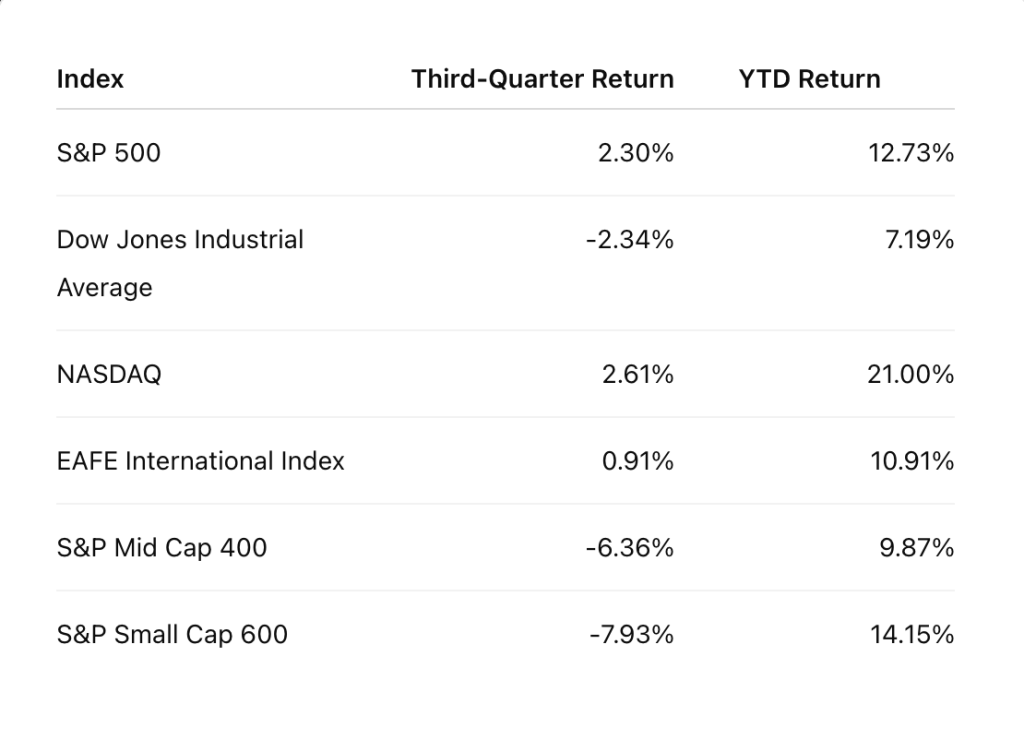 Fuel for the Market
Just like the first two quarters of the year, the war in Iran, and subsequent moves in oil prices, continued to have an impact on equity prices. After spiking in early April of this year to a high around $114.58 per barrel, West Texas Intermediate (WTI) oil prices declined late in the second quarter and markets hoped that inflation would fall with it. (2) We started the third quarter with WTI around $70, which would be the lowest price for the quarter.
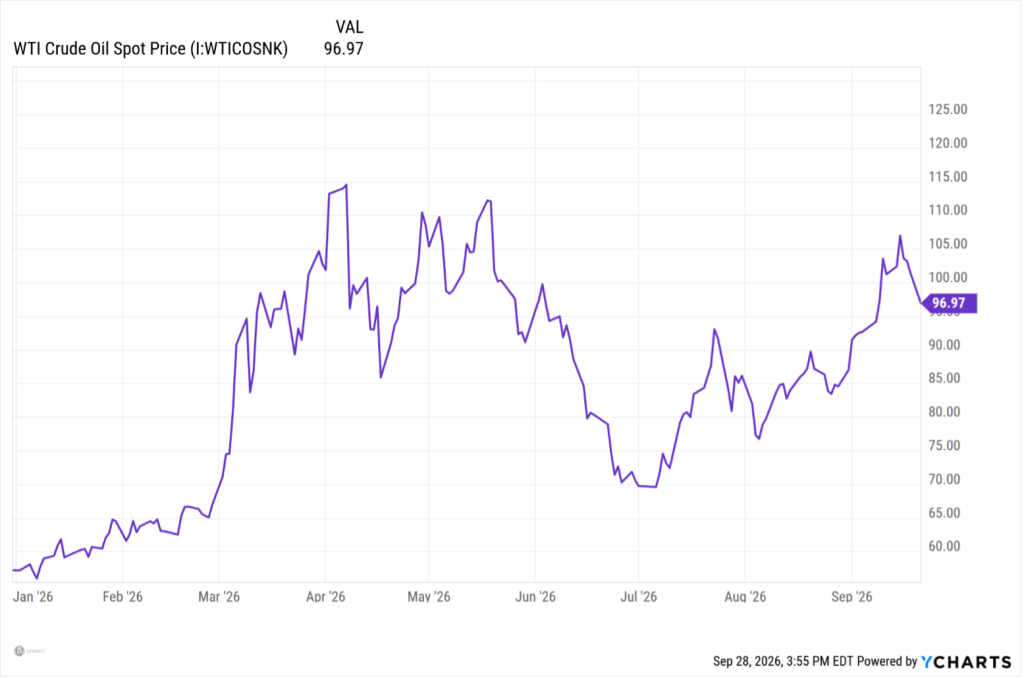
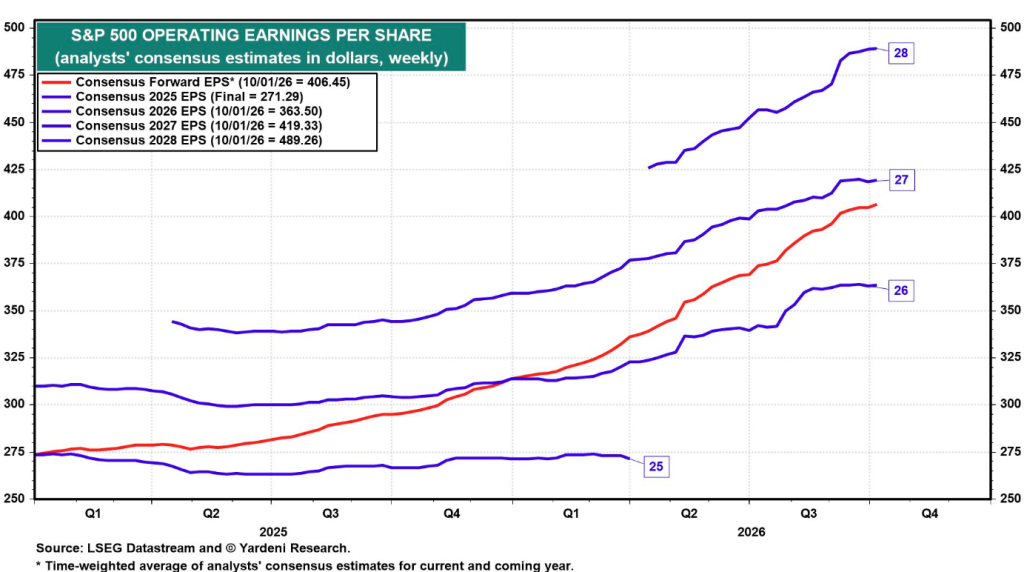
As oil prices rose in mid-July, second quarter earnings season kicked off. Earnings did not just beat expectations; they blew them away. You can see in the chart below the spike in earnings for the second quarter. After all the dust settled, S&P 500 companies showed earnings of $100.25 for the second quarter of 2026.
A lion’s share of the growth in earnings is from the continued massive investments in AI and the data centers that power this new technology. According to Goldman Sachs Research, global AI-related investment is projected to total about $1 trillion in 2026, with additional growth expected for 2027. (3)
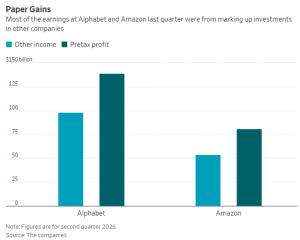
On top of excellent fundamental growth, there was some extra help to make the great earnings look even better. Several technology companies made large investments in private companies over the past several years (Space X, Anthropic and Open AI), and the value of those investments has grown dramatically. Some large technology companies also reported substantial non-operating gains tied to private-company investments
According to the Wall Street Journal, Alphabet and Amazon announced pre-tax profit of $138.75 and $80.86 billion for the second quarter, respectively. A substantial portion of those reported profits reflected non-operating gains, including a roughly $98 billion gain at Alphabet and about $53.4 billion of non-operating, pre-tax other income at Amazon.(4)
Tariff refunds also provided a benefit to some companies during the year. Not all of this went to publicly traded companies, but this has also been a tailwind to earnings. Taking away the investment gains and tariff refunds, the earnings quarter was excellent. Add them in, and this past earnings season was extraordinary.
A Shifting Forecast Across Sectors
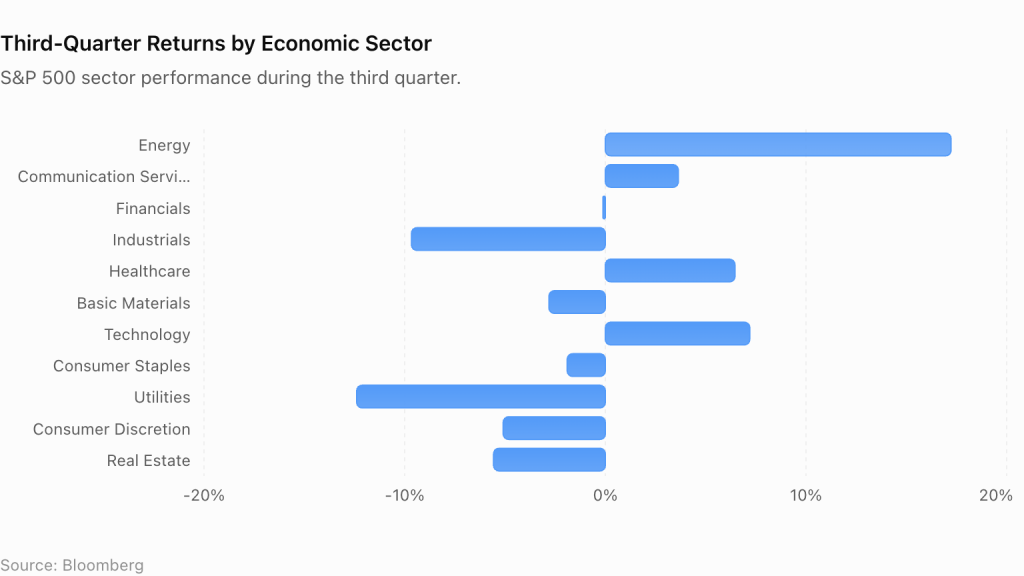
The third quarter was very much a rotational one for the 11 economic sectors that comprise the S&P 500. Rising oil prices catapulted the energy sector to the best performance of the past three months, with a 17.2% return. Technology and health care were the other winners for the quarter, with returns of 7.2% and 6.5%.
On the other side of the performance spectrum, the utilities sector was down 12.4% and industrials, led by a 23.9% decline in Caterpillar, were down 9.7% in the third quarter.
Looking Forward: Storm Clouds or Clearing Skies?
The final quarter of 2026 offers several factors investors may review constructively. First, considering how strong both first and second quarter earnings seasons were, it is reasonable to enter the third-quarter earnings season with somewhat firmer expectations. The previous chart shows that expectations for both the 3rd and 4th quarter earnings have continued to improve.
Second, we also have a mid-term election in November. The old saying is that the stock market likes certainty. The conclusion of the election will provide greater clarity to the makeup of Washington for the next two years. We just need to survive the onslaught of advertisements for the few weeks leading up to the election.
The FOMC will meet twice in the fourth quarter (late October and early December), and their decision regarding the federal funds rate could have a meaningful impact on stock prices. They will be looking very closely at inflation data and the labor markets to determine the direction to take the Fed Funds rate.
Those inflation numbers could be heavily impacted by oil prices, and if the conflict in Iran escalates or concludes. Any inflation or employment report released over the next few months could influence the FOMC’s decision-making and contribute to market volatility.
Will the intermediate and long end of the yield curve continue its climb, or will we finally see some stability with interest rates? It will be very difficult for the stock market to show stability if the bond market is volatile. Persistent bond-market volatility could make sustained stability in equity markets more difficult.
Finally, the trillion-dollar question for equity markets revolves around the continued massive spending on AI. It seems that the political push back on the construction of data centers has been growing the past several months. Stories regarding the potential demise of humanity, in my humble opinion, won’t help stem the rising concern about what issues the continued growth in AI could bring with it.
Will that data center and AI push back convert into a slower growth rate of the capital spending in the quarters and years to come? If it does not, strong corporate profits could remain supportive of equity valuations. If it does slow the spending growth, the current $420 in S&P 500 earnings for 2027 may need to be revised down. (5) Downward earnings revisions would likely create a more challenging backdrop for equity returns.
There should be no lack of impactful market events, both hot and cold, delivered in the last three months of 2026. Will rising debt levels and interest rates slow down either the top end of the consumer or the continued massive spend on the AI buildout? These two paths seem to be getting closer, and the current financial environment appears to be increasing the potential for some volatility ahead.
Sources:
1. FactSet – Earnings Insight. October 2, 2026.
2. U.S. Energy Information Administration – Petroleum & Other Liquids, Cushing, OK WTI Spot Price FOB. Accessed October 1, 2026.
3. Goldman Sachs – Global AI Investment is Forecast to Exceed $1 Trillion in 2026. Aug 7, 2026.
4. FactSet – S&P Earnings Season Update. July 24, 2026
5. Reuters – Data-Centre Reality Check Could Slam Brakes on AI Earnings Boom. August 5, 2026.
Advisory services, including investment management and financial planning, are offered through Oakworth Asset Management LLC, an SEC-registered investment adviser and a wholly owned subsidiary of Oakworth Capital Bank, Member FDIC and Equal Housing Lender. Registration with the U.S. Securities and Exchange Commission does not imply a certain level of skill or training. Investment products and services offered through Oakworth Asset Management LLC are not deposits, are not FDIC insured, are not bank guaranteed, may lose value, and are not insured by any federal or state government agency. Due to the ownership relationship between Oakworth Capital Bank and Oakworth Asset Management LLC, conflicts of interest may exist to the extent that either entity recommends the services of the other. Additional information regarding Oakworth Asset Management LLC, including its services, fees, and conflicts of interest, is available in the firm’s Form ADV at www.adviserinfo.sec.gov.
This communication is provided for informational and educational purposes only and should not be construed as investment, legal, tax, accounting, or other professional advice. The views and opinions expressed are those of the author(s) as of the publication date and are subject to change without notice.
The information presented is general in nature and is not intended to address the specific objectives, financial situation, or particular needs of any individual investor, account, or client relationship.
Nothing contained herein constitutes a recommendation to buy, sell, or hold any security, investment product, or investment strategy, nor should any information presented be relied upon as the basis for making an investment decision. References to specific securities, companies, industries, sectors, market indices, economic conditions, political developments, or geopolitical events are provided solely for informational and illustrative purposes and should not be interpreted as investment recommendations, endorsements, or predictions of future investment results. Investment strategies discussed may not be suitable for all investors. Individuals should consult their own financial, legal, tax, accounting, and other professional advisers before making any financial decisions.
This communication contains general information that may not be suitable for every investor and may be based on assumptions, estimates, opinions, and forward-looking statements that are subject to change. Actual results may differ materially from those expressed or implied, and no assurance can be given that any expectations, forecasts, or opinions discussed herein will be realized.
Investing involves risk, including the possible loss of principal. Past performance is not indicative of future results and should not be relied upon as a predictor of future performance. There is no guarantee that any investment strategy will achieve its objectives or avoid losses.
Any references to market indices are provided for illustrative purposes only. It is not possible to invest directly in an index. Index performance reflects the reinvestment of dividends, where applicable, but does not reflect the deduction of fees, expenses, or transaction costs, which would reduce returns. It should not be assumed that any client account will achieve returns comparable to any index discussed.
Information contained herein may be obtained from third-party sources believed to be reliable; however, Oakworth Asset Management LLC and Oakworth Capital Bank do not warrant or guarantee the accuracy, completeness, or timeliness of such information. References or links to third-party content are provided solely as a convenience and do not constitute an endorsement of any third-party views, products, or services.
Oakworth Asset Management LLC does not provide legal or tax advice. Individuals should consult their attorney, accountant, or tax adviser regarding their specific circumstances.