


Fixed Income: When Bonds Diversify Less
Outside of the COVID-19 years between 2020 and 2022, we grew accustomed to docile activity in yields with stagnant price movements in the fixed income market. To be fair, that “boring” nature of the asset class is a welcome component in an investment portfolio. Fixed income has historically offered three important characteristics for investors: preservation of principal, income generation, and, depending on inflation trends, diversification from equities. The diversification benefit is often most pronounced during periods of economic growth shocks. Historically, during an economic contraction, or even a mild mid-cycle slowdown, earnings can be negatively affected and policy rates can be lowered. This can lead to money flowing out of equities and into fixed income, lifting bond prices and pushing equities lower. Following COVID-19, supply disruptions, fiscal stimulus and energy shocks resulted in persistent inflation.
This led to rising yields as investors demanded a higher return on their investment, which tested equity valuations. This resembles the inflationary 1970s and early 1980s, when supply shocks and aggressive monetary tightening produced a positive stock–bond correlation. This differed from the low and stable inflation environment from roughly 2000 through 2019 – and other disinflationary periods which enabled central banks greater flexibility to ease into downturns and restored bonds’ diversification benefit.
Rates, Inflation and Duration Risk
Given the current environment, the third quarter of this year was marred by steady increases in yields across the yield curve with the UST 10-year yield gaining approximately 85 basis points, from 4.44% on June 30 to 5.29% on Sept. 30. (1) Pressure on rates was accelerated by rising oil prices amid heightened tensions in the Middle East, as well as by fixed income markets digesting additional capital spending from hyperscalers on top of the more than $1 trillion previously announced to fund the AI buildout.
Additionally, fiscal and monetary policy offered little reprieve from massive debt supply and pushed short-term interest rates higher following a 25-basis point federal funds hike, from 3.75-4.00% at the September Federal Open Market Committee meeting.
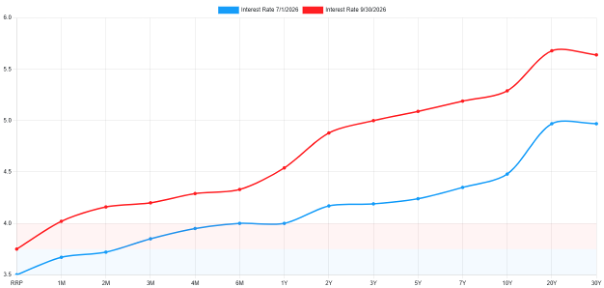
All this being said, we are cognizant of the inflationary period we have lived in for over four years which has increased interest rate risk on the longer end of the yield curve. This, paired with the trillions of dollars of sovereign and AI-related debt that may need to be issued at substantially higher interest rates than those we became complacent with over the better part of 15 years, leaves us hesitant to pounce on what may appear to be “attractive yields.” The interest rate risk embedded in those yields could result in principal losses and may reduce fixed income’s diversification benefit in certain market environments. We are simply not confident in fixed income’s third characteristic of diversification from equity markets due to rate sensitivity during this inflationary part of the economic cycle. We have kept duration within our fixed income allocation on the shorter side and continue to seek ways to further diversify our client portfolios.
Equity: Looking Beyond the Largest Stocks
Diversification within our equity allocation has also played an important role in positioning both year-to-date and over the previous quarter. With the top 10 stocks in the S&P 500 accounting for nearly 38% of the index (as of Aug. 31, 2026), there is concentration risk present today in owning the benchmark index. This was not the case just 10 short years ago when the largest 10 stocks in the S&P 500 accounted for under 20% of the index. To add to that, half of those largest ten stocks ten years ago were more value-oriented companies, such as Berkshire Hathaway, Exxon Mobil, Johnson & Johnson, JPMorgan Chase, and Wells Fargo. Today, nine of the ten largest companies in the S&P 500 have meaningful exposure to the AI theme. (2)
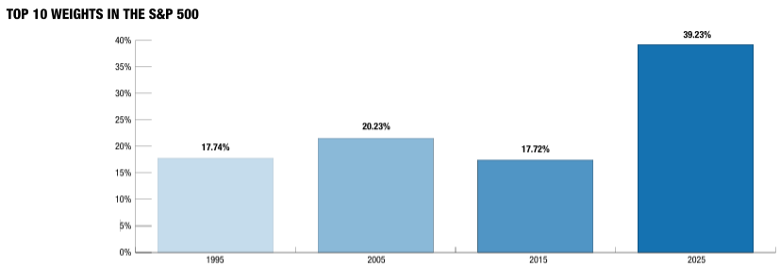
Managing Concentration Risk
We have gradually addressed that concentration risk by overweighting three “old economy” sectors which we view as solid value with more opportunity than headwinds ahead. Overweighting the energy sector has provided differentiated exposure during a period of rising oil prices at a time when oil prices and inflation expectations have been a drag on the broader equity market. It is quite remarkable that the entire energy sector’s weight in the S&P 500 currently stands near 3.5% compared with Nvidia’s at more than 8%. We also remain overweight financials during a multiyear period of increasing interest rates, especially on the long end of the curve.
Should a steepening yield curve present challenges to the equity market, financials could benefit in some circumstances from wider lending spreads, although the effect would vary across institutions and depend on funding costs, credit conditions and the shape of the curve. Still another way we seek safety and stability within the equity sleeve of our clients’ portfolios is allocating to the defensive health care sector.
Due to these risks we have kept our equity allocation subdued relative to both our benchmark and our historical norms. From Oct. 11, 2022, through Sept. 30, 2026, the S&P 500 returned 125.4% on a total return basis, more than doubling in just under four years. (4) This performance in major averages has coincided with substantial gains among companies associated with the AI buildout leading to the concentration at the top of the S&P 500. Given the recent strength, scaling back in equity exposure helps maintain an appropriate risk profile for our clients while leaving available capital on the sideline should volatility arise or unique opportunities present themselves. It wasn’t that long ago that owning the S&P 500 index was a fairly diversified strategy because it provided exposure to a myriad of the largest companies in the U.S. Today, we have taken steps to prudently ensure appropriate exposures following strong investor enthusiasm in the AI buildout.
Commodities : Diversification Beyond Stocks and Bonds
Diversification does not stop at a single asset class, though. During the quarter we further increased ownership of assets that can respond positively even in a tougher macro environment. The case for investments beyond traditional stocks and bonds has strengthened, which is why assets such as gold and agricultural commodities can have a meaningful place in well-diversified portfolios.
Gold offers a simple proposition: it is a scarce asset that is not someone else’s liability. Unlike fiat currency, gold cannot be printed to finance a deficit. Over long periods, that scarcity can make gold an attractive store of value when investors become concerned about inflation, currency debasement or the purchasing power of cash. In an environment of large government deficits and elevated debt levels, the possibility that currencies gradually lose purchasing power is a risk worth diversifying against.
Agricultural commodities provide another level of diversification. Their value is tied to the physical world and, ultimately, to supply and demand. Consider the potential development of a significant El Niño event: a shift in Pacific Ocean temperatures can alter rainfall and temperatures across major agricultural regions, affecting crop yields and food prices around the world. (5) These are forces that have little to do with corporate earnings or bond yields, yet they can have a meaningful impact on the broader economy, especially if the supply of agricultural products is challenged. Fertilizer prices have also risen sharply, with higher energy costs and disruptions to major exporting regions putting pressure on global supply. (6) Elevated fertilizer costs could affect planting decisions and crop yields into 2027, particularly in import-dependent markets such as Brazil.(7) The “disruption” could trickle down well beyond the effects of changing weather patterns. (8) While fertilizer prices may eventually normalize, the near-term squeeze could reduce crop supply just as global inventories are becoming less comfortable.
Together, gold and agricultural commodities can provide differentiated exposures within a broader investment portfolio. The world is facing a combination of fiscal expansion, geopolitical uncertainty, changing weather patterns, and evolving supply chains – all of which can create unexpected pressures on the price of real goods. These variables support preparing portfolios for a wider range of potential outcomes.
Bottom Line
Selective equity exposure, cautious management of interest rate sensitivity and a diverse mix of holdings have reflected our emphasis on managing portfolio risk across multiple market environments. Looking ahead, we will be mindful of the potential for market volatility and will remain measured in our approach, emphasizing capital preservation, diversification and selectivity. Maintaining discipline yet staying flexible is intended to position us to seek opportunities where the potential reward justifies the risk.
Sources:
- S. Department of the Treasury – Daily Treasury Rates. Accessed Oct. 1, 2026.
- Bloomberg – Goldman Sees Hyperscaler AI Capex Rising 50% to $1.2 Trillion. September 25, 2026.
- S&P Global – S&P 500. Accessed October 1, 2026.
- YCharts — S&P 500 Total Return, Oct. 11, 2022, through Sept. 30, 2026. Accessed October 2, 2026.
- Climate Prediction Center – Official NOAA CPC ENSO Strength Probabilities. Issued September 2026.
- World Bank — Commodity Markets Outlook, April 2026
- USDA Foreign Agricultural Service — Global fertilizer market: supports Brazil’s reliance on imported fertilizer. USDA fertilizer market analysis. April 6, 2026.
- FAO — Fertilizer scarcity and future harvests, May 2026.
Advisory services, including investment management and financial planning, are offered through Oakworth Asset Management LLC, an SEC-registered investment adviser and a wholly owned subsidiary of Oakworth Capital Bank, Member FDIC and Equal Housing Lender. Registration with the U.S. Securities and Exchange Commission does not imply a certain level of skill or training. Investment products and services offered through Oakworth Asset Management LLC are not deposits, are not FDIC insured, are not bank guaranteed, may lose value, and are not insured by any federal or state government agency. Due to the ownership relationship between Oakworth Capital Bank and Oakworth Asset Management LLC, conflicts of interest may exist to the extent that either entity recommends the services of the other. Additional information regarding Oakworth Asset Management LLC, including its services, fees, and conflicts of interest, is available in the firm’s Form ADV at www.adviserinfo.sec.gov.
This communication is provided for informational and educational purposes only and should not be construed as investment, legal, tax, accounting, or other professional advice. The views and opinions expressed are those of the author(s) as of the publication date and are subject to change without notice.
The information presented is general in nature and is not intended to address the specific objectives, financial situation, or particular needs of any individual investor, account, or client relationship.
Nothing contained herein constitutes a recommendation to buy, sell, or hold any security, investment product, or investment strategy, nor should any information presented be relied upon as the basis for making an investment decision. References to specific securities, companies, industries, sectors, market indices, economic conditions, political developments, or geopolitical events are provided solely for informational and illustrative purposes and should not be interpreted as investment recommendations, endorsements, or predictions of future investment results. Investment strategies discussed may not be suitable for all investors. Individuals should consult their own financial, legal, tax, accounting, and other professional advisers before making any financial decisions.
This communication contains general information that may not be suitable for every investor and may be based on assumptions, estimates, opinions, and forward-looking statements that are subject to change. Actual results may differ materially from those expressed or implied, and no assurance can be given that any expectations, forecasts, or opinions discussed herein will be realized.
Investing involves risk, including the possible loss of principal. Past performance is not indicative of future results and should not be relied upon as a predictor of future performance. There is no guarantee that any investment strategy will achieve its objectives or avoid losses.
Any references to market indices are provided for illustrative purposes only. It is not possible to invest directly in an index. Index performance reflects the reinvestment of dividends, where applicable, but does not reflect the deduction of fees, expenses, or transaction costs, which would reduce returns. It should not be assumed that any client account will achieve returns comparable to any index discussed.
Information contained herein may be obtained from third-party sources believed to be reliable; however, Oakworth Asset Management LLC and Oakworth Capital Bank do not warrant or guarantee the accuracy, completeness, or timeliness of such information. References or links to third-party content are provided solely as a convenience and do not constitute an endorsement of any third-party views, products, or services.
Oakworth Asset Management LLC does not provide legal or tax advice. Individuals should consult their attorney, accountant, or tax adviser regarding their specific circumstances.