


The second quarter marked a notable shift in tone as the elevated volatility that defined the beginning of the year began to recede. While uncertainty remained present, investors grew increasingly comfortable as geopolitical tensions surrounding the conflict with Iran eased, reducing one of the market’s largest near-term sources of anxiety. At the same time, economic data continued to indicate resilient economic growth, moderate inflation and a labor market that even showed some signs of heating up. Together, these developments allowed markets to regain confidence and risk assets broadly recovered.
Equity Markets Broaden Their Leadership
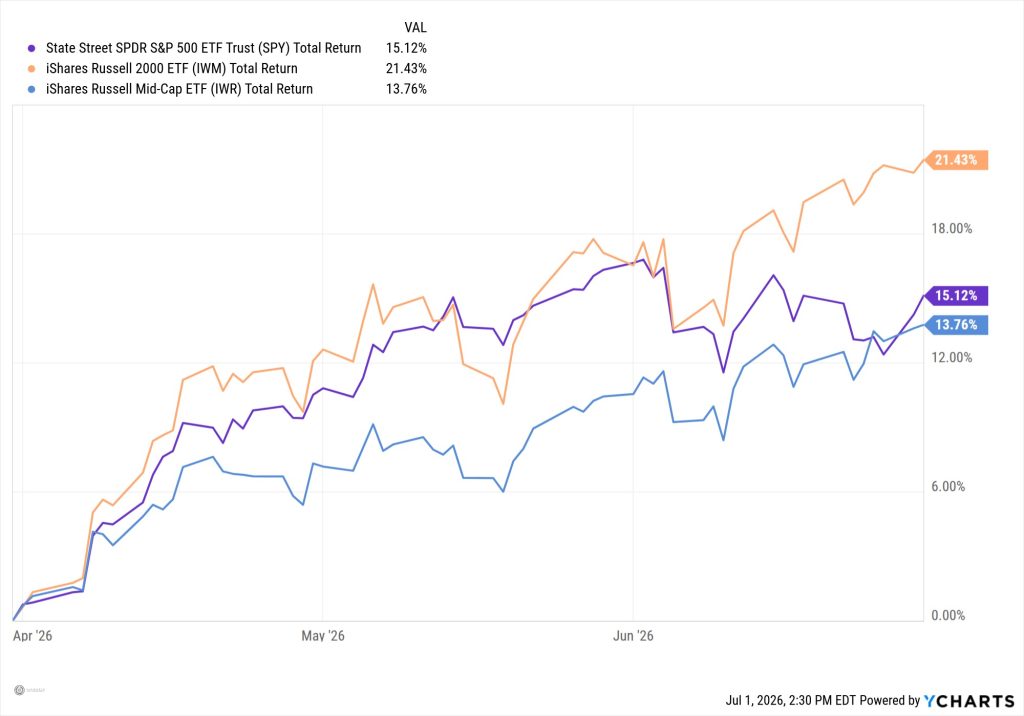
Equity markets experienced a meaningful improvement in both breadth and participation. Unlike prior periods, when returns were heavily concentrated among a narrow group of large-cap technology companies, the second quarter saw leadership broaden across sectors, styles and market capitalizations. Large-cap stocks continued to perform well, but small- and mid-cap companies also participated more meaningfully as investors became increasingly willing to move beyond the market’s traditional leaders.
This broadening of participation appears to be a constructive development, suggesting a healthier market environment than one driven by only a handful of companies.
MARKET GAINS EXTEND BEYOND LARGE-CAP STOCKS
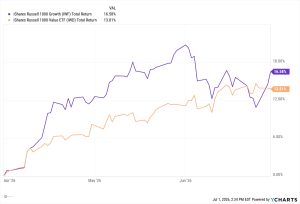
Growth-oriented sectors, particularly technology and AI-related companies, recovered much of the weakness experienced during the first quarter as investor confidence improved and fears surrounding higher interest rates moderated. While valuations in many of these areas remain elevated, earnings growth has generally continued to support investor optimism. Importantly, the recovery was not isolated to growth. Cyclical and value-oriented sectors, including industrials, financials and select consumer discretionary companies, also generated positive returns as the solid consumer data continued to alleviate fears.
YEAR-TO-DATE PERFORMANCE: GROWTH VS. VALUE
International equities likewise benefited from the improved backdrop. Developed and emerging markets posted positive returns as easing geopolitical concerns, stabilizing currencies, and improving global risk sentiment supported investor confidence. While geopolitical risks remain present, markets appeared increasingly willing to look through near-term headlines and focus instead on underlying economic fundamentals.
Perhaps the most notable change during the quarter was the retreat in market volatility. Rather than the persistent and elevated volatility experienced earlier in the year, volatility declined meaningfully as uncertainty primarily surrounding Iran dissipated. Markets remained sensitive to economic data and Federal Reserve communications, but price movements became more measured and orderly as investor sentiment improved.
The broadening of market leadership was particularly encouraging from a portfolio construction perspective.
- Because our equity allocations have consistently emphasized diversification across sectors, styles, and market capitalizations, the expansion in market participation created additional opportunities beyond the narrow concentration that characterized much of the previous year.
- Our continued focus on valuation discipline also allowed us to benefit from improving sentiment while avoiding excessive exposure to areas where expectations remain particularly elevated.
Fixed Income Reasserts Its Role
Fixed income also delivered positive results during the quarter, fulfilling its role as a source of stability, income and portfolio diversification. As interest rate volatility moderated and Treasury yields stabilized, bond prices generally performed well alongside equities which is a welcome development following the heightened volatility experienced earlier in the year. Importantly, investors were once again reminded that fixed income can generate income and has the potential to contribute positively to portfolio returns, particularly in today’s higher-yield environment.
Portfolio Positioning Remains Disciplined
Our decision to maintain a relatively short-duration fixed income allocation continued to reflect our view that preserving flexibility remains important in an environment where inflation and monetary policy uncertainty have not been fully resolved. While longer-duration bonds benefit from periods of declining yields, our shorter-duration positioning continued to offer competitive income opportunities with less sensitivity to changes in interest rates. Coupled with our emphasis on higher-quality credit, this approach remains consistent with our objective of managing interest-rate sensitivity and downside risk while seeking competitive risk-adjusted returns.
The current yield environment continues to provide an attractive foundation for fixed income investors. Higher starting yields have historically contributed meaningfully to total return but also provide greater flexibility to redeploy capital as opportunities arise.
Even as market conditions improved during the quarter, maintaining liquidity and optionality remains an important component of our investment process.
The second quarter also reinforced another important principle of our investment philosophy: markets are dynamic, and investor sentiment can shift quickly. Just as periods of elevated volatility eventually normalize, periods of strong market performance should be viewed with appropriate perspective. Rather than reacting to short-term headlines or attempting to forecast near-term market movements, we remain focused on maintaining diversified portfolios that can adapt to changing conditions over time.
Looking Ahead
Our current allocation reflects that philosophy. While the investment backdrop has improved, valuations across portions of the equity market remain elevated, and economic and geopolitical risks have not disappeared entirely. As a result, we continue to believe that maintaining a balanced and disciplined portfolio remains an appropriate approach. Our modestly conservative positioning provides the flexibility to increase risk exposure should valuations become more compelling while also preserving the ability to become more defensive if conditions deteriorate.
Looking ahead, investors will continue to focus on inflation trends, labor market conditions, corporate earnings, Federal Reserve policy, and geopolitical developments. While the near-term outlook has improved meaningfully from where it stood just a few months ago, uncertainty remains a permanent feature of investing. Our focus will remain on identifying opportunities where long-term fundamentals justify investment while continuing to manage risk thoughtfully across portfolios.
Advisory services, including investment management and financial planning, are offered through Oakworth Asset Management LLC, an SEC-registered investment adviser and a wholly owned subsidiary of Oakworth Capital Bank, Member FDIC and Equal Housing Lender. Registration with the U.S. Securities and Exchange Commission does not imply a certain level of skill or training. Investment products and services offered through Oakworth Asset Management LLC are not deposits, are not FDIC insured, are not bank guaranteed, may lose value, and are not insured by any federal or state government agency. Due to the ownership relationship between Oakworth Capital Bank and Oakworth Asset Management LLC, conflicts of interest may exist to the extent that either entity recommends the services of the other. Additional information regarding Oakworth Asset Management LLC, including its services, fees, and conflicts of interest, is available in the firm’s Form ADV at www.adviserinfo.sec.gov.
This communication is provided for informational and educational purposes only and should not be construed as investment, legal, tax, accounting, or other professional advice. The views and opinions expressed are those of the author(s) as of the publication date and are subject to change without notice.
The information presented is general in nature and is not intended to address the specific objectives, financial situation, or particular needs of any individual investor, account, or client relationship.
Nothing contained herein constitutes a recommendation to buy, sell, or hold any security, investment product, or investment strategy, nor should any information presented be relied upon as the basis for making an investment decision. References to specific securities, companies, industries, sectors, market indices, economic conditions, political developments, or geopolitical events are provided solely for informational and illustrative purposes and should not be interpreted as investment recommendations, endorsements, or predictions of future investment results. Investment strategies discussed may not be suitable for all investors. Individuals should consult their own financial, legal, tax, accounting, and other professional advisers before making any financial decisions.
This communication contains general information that may not be suitable for every investor and may be based on assumptions, estimates, opinions, and forward-looking statements that are subject to change. Actual results may differ materially from those expressed or implied, and no assurance can be given that any expectations, forecasts, or opinions discussed herein will be realized.
Investing involves risk, including the possible loss of principal. Past performance is not indicative of future results and should not be relied upon as a predictor of future performance. There is no guarantee that any investment strategy will achieve its objectives or avoid losses.
Any references to market indices are provided for illustrative purposes only. It is not possible to invest directly in an index. Index performance reflects the reinvestment of dividends, where applicable, but does not reflect the deduction of fees, expenses, or transaction costs, which would reduce returns. It should not be assumed that any client account will achieve returns comparable to any index discussed.
Information contained herein may be obtained from third-party sources believed to be reliable; however, Oakworth Asset Management LLC and Oakworth Capital Bank do not warrant or guarantee the accuracy, completeness, or timeliness of such information. References or links to third-party content are provided solely as a convenience and do not constitute an endorsement of any third-party views, products, or services.
Oakworth Asset Management LLC does not provide legal or tax advice. Individuals should consult their attorney, accountant, or tax adviser regarding their specific circumstances.