


What is the true state of the U.S. economy?
After all, it seems as though the powers that be seasonally adjust, revise and otherwise massage the data to such an extent, it is nearly impossible for the average American to know what is actually happening.
THE LABOR MARKET
To that end, this past quarter, the Bureau of Labor Statistics (BLS) announced that 911,000 previously reported payroll jobs didn’t actually exist for the period from April 2024 through March 2025. Obviously, that isn’t an insignificant revision. In fact, it is the largest one since at least 2000, coming on the heels of last year’s negative adjustment of 818,000.1
For its part, the Bureau of Economic Analysis (BEA) originally announced U.S. Gross Domestic Prodcut (GDP) grew at an annualized 3.0% rate during the 2nd quarter of 2025.
→Then, it reported it had actually grown 3.1%.
→Finally, just before the end of the 3rd quarter, it announced the economy ultimately grew at a 3.8% annual rate for the previous quarter.
Who knows what the economic growth would be if the BEA just had enough time to keep revising its data? Further, the headline numbers can be a little deceiving even without all of the revisions.
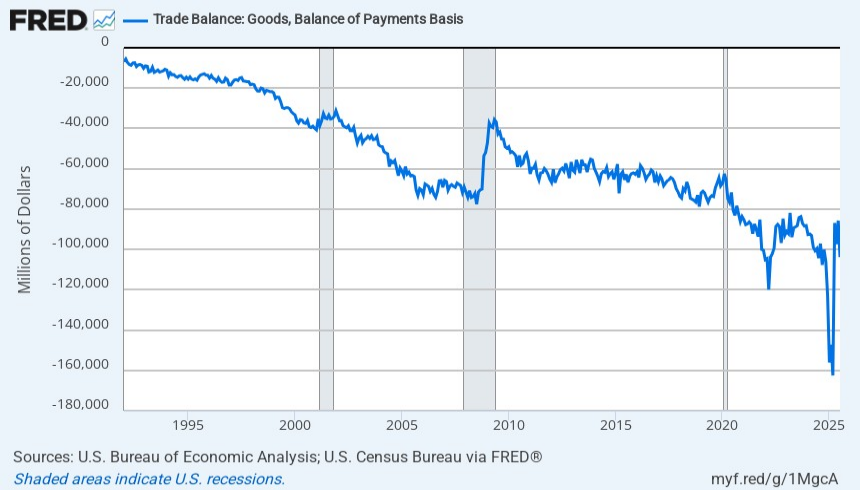
In fact, the BEA now estimates the U.S. economy shrank 0.6% during the 1st quarter of 2025. However, pretty much all the decline was due to businesses stocking up on their inventories and otherwise front-end loading purchases to stay ahead of the administration’s tariffs. Obviously, this caused our already-bloated trade deficit to balloon.
[Design team – please see chart styling in template. High res file sent in drop box]
Historic Swings in the Trade Deficit in 2025
GDP & TRADE
To put that in perspective, the BEA now reports the deterioration in our trade balance during Q1 took 470 basis points (4.70%) off the overall GDP equation. Of course, a lot of those imports went straight into inventories, which the agency claims added 258 basis points back. Yes, it can be a little confusing.
Now, not surprisingly, the trade deficit improved dramatically during the 2nd quarter as U.S. businesses drew down more inventories instead of buying more from overseas. That shift showed up in the GDP equation, adding 483 basis points (4.83%), while inventory drawdown substracted 344 basis points (3.44%) to the GDP equation respectively.2
Put simply, the economy wasn’t really as weak as the BEA reported for the 1st quarter. Conversely, it wasn’t as strong as it said it was during the 2nd quarter. It is just the way the equation works, and the equation can sometimes be a little messy.
SO, BRASS TACKS, WHAT IS THE TRUE HEALTH OF THE U.S. ECONOMY?
While it is impossible to give a definitive answer — especially since the agencies in charge of calculating such things keep revising their data — the BEA includes something called “final sales to domestic purchasers” in its GDP report. While far from perfect, it probably is as good a reflection of what the “average American” feels as any.
Right now, by this measure and before any future revisions, the U.S. economy probably grew around 1.4% during the first 3-months of the year, and about 2.4% last quarter. Again, probably.
Perhaps that helps to explain why the Federal Reserve cut the target overnight lending rate during September, even though the BEA was reporting 3.8% GDP growth. Obviously, that wouldn’t make a lot of sense otherwise.
Further, it wouldn’t make a lot of sense if the BLS hadn’t made such a massive negative revision to the payroll data it had previously reported.
You see, the Fed has a dual-mandate: price stability and full employment. Maximum economic growth, interestingly enough, is not a part of that equation.
INFLATION
To that end, anyone who has recently been to the grocery store will tell you inflation is still a problem. If not inflation — the growth rate of price changes — then prices themselves. However, it is far from clear whether tinkering around with the overnight rate will actually have any impact on all of the items in your cart.
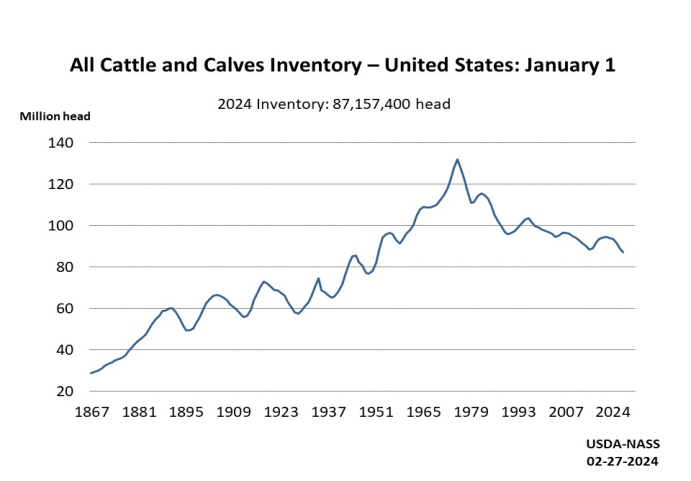
Beef is a perfect example, and the cut doesn’t matter. Ground beef, roasts, steaks and even oxtails are all up sharply in price. Why? Drought conditions in the Midwest drove up the cost of fodder a few years ago, and farmers processed a larger-than normal-amount, including heifers. Obviously, fewer heifers means fewer calves. Fewer calves mean fewer cows to process. Fewer cows mean higher beef prices. Voilà.
Source: US Department of Agriculture
I am not sure what the overnight rate has to do with it. In fact, some can argue higher interest rates might actually exacerbate the problem. The U.S. cattle supply is at its lowest level in decades.
THE HOUSING MARKET
Housing faces a strikingly similar challenge. There simply aren’t enough homes available for sale. As a result, prices have increased substantially, which has forced many potential homebuyers into the rental market. Unfortunately, a greater demand for rental units drives rents higher.
Since the “owners equivalent rent of primary residence” constitutes roughly 26% of the Consumer Price Index (CPI), there is upside pressure on the official inflation gauges when people can’t afford to buy single-family homes.
Put another way, higher interest rates generally make housing less affordable. When housing is unaffordable, more people are forced into leasing, which causes rents to go up. This causes the inflation gauges to remain elevated, which forces the Fed to keep the overnight rate higher than anyone would like.3
Basically, anything that drives down rental demand should put downward pressure on the official inflation gauges. Voilà.
In essence, changes in monetary policy will have little impact on some items which are currently hitting consumers’ wallets. Further, and admittedly somewhat counterintuitively, higher interest rates may be inflationary in certain economic sectors, like housing.
Therefore, some believe the Fed could potentially support U.S. consumer’s purchasing power by actually lowering the overnight rate, making money less expensive in the financial system, thereby reducing financing costs. Go figure.
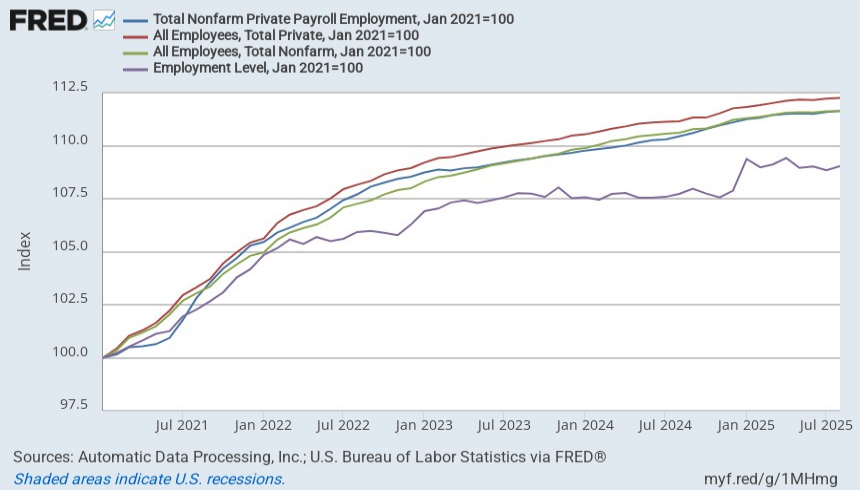
As for full employment, well, if you have liked the labor markets over the past several quarters, you will probably like them for a little while longer. Nothing in the crystal ball or tea leaves suggests the U.S. economy is going to come to a screeching halt. As such, there is little to suggest hiring will collapse in the near-term.4
However, given the relatively modest economic growth rates we have recently experienced, a sudden surge in new employment is almost equally as unlikely. Essentially, the U.S. economy should be a net creator of new jobs over the next couple of quarters, but the numbers are likely to be underwhelming.
New Payroll Growth Has Basically Flatlined
ARTIFICIAL INTELLIGENCE
I would be remiss if I didn’t mention something about Artificial Intelligence (AI). After all, it has been a — if not the — primary topic in the business world for some time. Will AI wreck the economy or be a blessing for it? Inquiring minds want to know.
The probable-case scenario is that AI will play havoc with individuals while creating massive benefits for the economy as a whole. You see, the people who don’t learn to adapt to and utilize the newest technologies will be at a severe disadvantage in the workforce. They WILL be the first ones to lose their jobs.5
Intuitively, this set of workers probably doesn’t drive much value-add or wealth creation in the U.S. economy. Conversely, those that DO adapt and use AI effectively will develop new technologies, industries and jobs which don’t currently exist! Frankly, this makes AI far more exciting than terrifying to me.
As such, and in the end, when people ask me about AI’s potential impact on the U.S. labor markets, I usually tell them there could be some short-term pain for some. However, in the longer term, it may prove to be a massive job creator, and I can’t wait to see what changes it brings us.
So, where does that leave us? What is the true state of the economy? What is likely to happen moving forward?
Contrary to popular belief, the U.S. economy is neither as bad as many believe nor as strong as some would contend. However, the potential for error appears to be the downside due to a somewhat softer labor market. As a result, in our view, the market should expect the Federal Reserve to cut the target overnight lending rate at least 3 more times before this easing cycle is over, though the number and timing remain uncertain.
Hopefully, that will be enough to get things humming again.
SOURCES:
- The Bureau of Labor Statistics Economic – Current Employment Statistics Preliminary Benchmark Summary (September 2025)
- The Bureau of Economic Analysis – 2nd Quarter Gross Domestic Product 2025 by Industry, Corporate Profits and Annual Update (September, 25, 2025)
- The Bureau of Labor Statistics – Consumer Price Index Relative Importance and Weight
- The Bureau of Labor Statistics – The Employment Situation (August 2025)
- Common Cents – Artificial Intelligence. The Great American Job Killer? (September 2025)
Oakworth Asset Management is a registered investment advisor. All advisory services, including investment management and financial planning, are offered through Oakworth Asset Management, LLC. Oakworth Asset Management is owned by Oakworth Capital Bank, member FDIC, Equal Housing Lender.
Investment products and services offered via Oakworth Asset Management, LLC are independent of the products and services offered by Oakworth Capital Bank and are NOT FDIC INSURED, NOT BANK GUARANTEED, and MAY LOSE VALUE.
The information, opinions, comments, statements, views or recommendations expressed are general in nature and should not be considered professional, tax or legal advice; or as an offer to buy or sell or to make or consider any investment or course of action.
For more information visit Oakworth.com.
New Payroll Growth Has Basically Flatlined