


As we entered the 3rd quarter, there were three main questions that, in our opinion, could influence whether stocks could continue their climb higher.
- Would the Federal Reserve cut the Fed Funds rate?
- Could the elevated pace of spending on AI infrastructure continue?
- Would corporate earnings season remain strong in the face of new tariffs?
The quick answer to all three questions appears to be a resounding yes.
THE FED
The labor market showed enough weakness in 3rd quarter, alongside stable inflation numbers, for the Federal Reserve to reduce interest rates by 25 basis points in September, with the possibility of even more cuts in late October and mid-December. Historically, small cap stocks perform well during Fed rate cut cycles, and the 3rd quarter this year was no different. The S&P Small Cap 600 index returned 8.7% — above the S&P 500 index— trailing only the Nasdaq Composite index.1
AI AND THE MAGNIFICENT SEVEN
While the Fed had an influence on the equity markets last quarter, the Magnificent 7 and the AI trend remained significant drivers of stock returns. The stocks with the largest impact on the S&P 500’s strong quarterly return include Apple (+26.7%), Nvidia (+15.3%), Google (+36.8%) and Tesla (+37.0%), all card-carrying members of the Magnificent 7. Other technology stocks, including Oracle (+34.8%) and Broadcom (+22.0%), also added to the S&P 500’s move higher.
Those same large growth companies that dominate the S&P 500 make up even a larger percentage of the Nasdaq, which led all index returns in the 3rd quarter with an 8.8% return.
All three economic sectors that include members of the Magnificent 7 — technology (+11.3%), consumer discretion (+10.3%) and communication services (+9.1%) — were the 3 best performing sectors of the quarter. The defensive sectors were among the worst performing. Consumer staples showed a return of -3% while health care was up a measly 1.5%.
The exception among defensive sectors was utilities, posting a return of 6.8% in 3rd quarter (see chart below)1. This positive return may have been influenced by ongoing AI infrastructure built out. If AI infrastructure continues to expand at the current rate, the current electric grid will likely face significant increased demand. Economics 101 tells us that in most cases when a product’s demand is growing faster than the supply, prices tend to rise. This may bode well for potential electrical sector fundamentals
After significantly outperforming domestic stocks in the 1st quarter, and keeping pace in the 2nd quarter, international stocks struggled in the 3rd quarter. Over the last three months, the largest international stock index, the EAFE, gained 3.5%— a lower return than any domestic stock index.
| Index | 3rd Quarter Return | Economic Sector | 3rd Quarter Return | |
| S&P 500 | 7.79% | Technology | 11.3% | |
| NASDAQ | 8.82% | Consumer Discretion | 10.3% | |
| Dow Jones Industrial Avg | 5.22% | Communication Services | 9.1% | |
| S&P Mid Cap 400 | 5.18% | Utilities | 6.8% | |
| S&P Small Cap 600 | 8.66% | Energy | 5.3% | |
| EAFE International Index | 4.23% | Industrials | 4.5% | |
| Healthcare | 3.2% | |||
| Financials | 2.9% | |||
| Basic Materials | 2.1% | |||
| Real Estate | 1.7% | |||
| Consumer Staples | -3.2% |
Source: Bloomberg Financial
EARNINGS SEASON
There were some questions as we entered 2nd quarter earnings season. With new tariffs being implemented, would corporations pass the increase in costs along to the consumer? Would that lead to a downturn in spending? Or would companies absorb the tariffs, leading to lower profit margins?
In the end, both profit margins and consumer spending held firm, resulting in a strong 2nd quarter earnings season, led once again by the Magnificent 7. Those companies posted year-over-year earnings growth of 26.6%; the other 493 members of the S&P 500 showed earnings growth of 8.1%. Looking ahead to the next few quarters, analysts are expecting earnings growth rate for the Mag 7 to fall to 14.5%.2
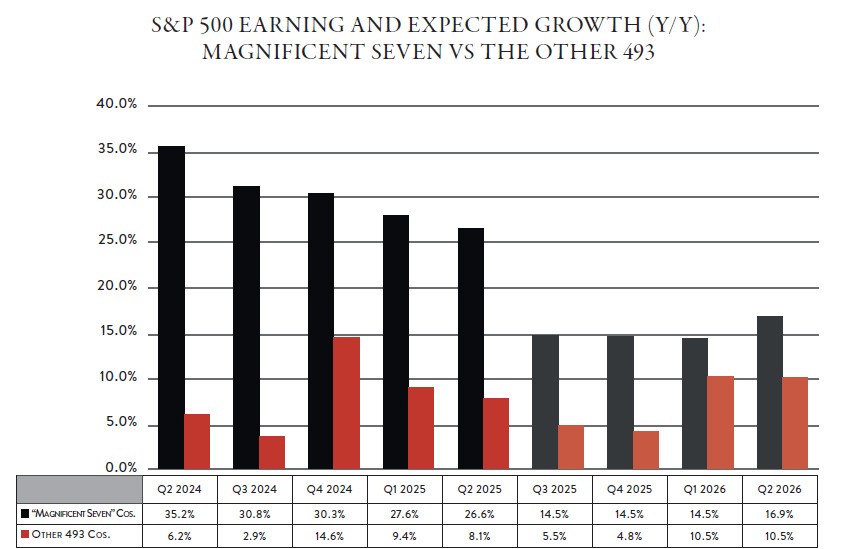
Source: FactSet
One unexpected shift in the 3rd quarter was the drop in market volatility. I’m not sure we can attribute that to a lack of news headlines over the past three months, as the first two quarters of the year were extremely volatile for stocks. During Q1 and Q2 of 2025, the S&P 500 saw 40 trading days with a price change (both positive and negative) of greater than 1%. Third quarter only gave us 4 of those volatile days. Is it possible that investors are becoming numb to the news cycle and simply look past the daily headlines?
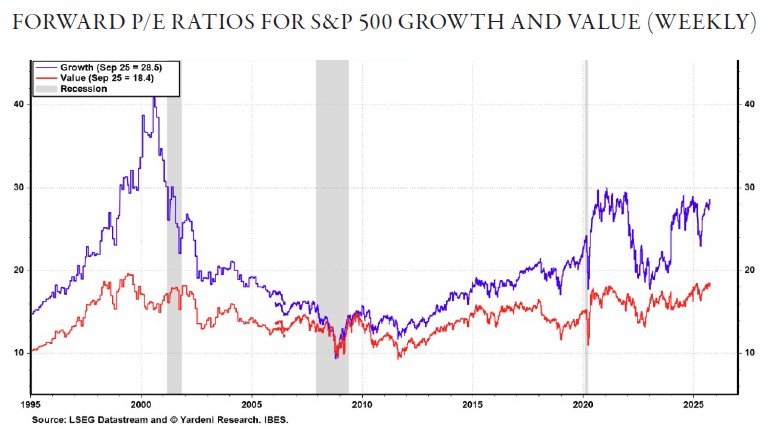
It was a “drift higher” quarter for the stock market. This has left stocks trading at elevated valuation levels. As we have mentioned before, valuations are historically not a great predictor of stock returns, but experience shows that it does increase the potential downside risk. Both growth stocks (28.5x earnings) and value stocks (18.4x earnings) are trading near recent highs.3
LOOKING FORWARD
The fourth quarter of 2025 could be a very interesting quarter for the stock market. The labor market has fallen into a “Goldilocks” zone for equities; cool enough to allow the Fed cut interest rates, but not so cold that we have seen a decline in corporate earnings. The question is… will it stay there?
Roughly two-thirds of all spending in this economy is driven by consumers, and people tend to spend less when they are fearful of losing their job. We seem to be on the tail end of the strongest labor market in decades, and most workers have felt very confident in their job security. They have spent accordingly.
Hiring seems to have slowed to a near halt, but we have not gotten to the point of significant layoffs. If weakness in the labor markets continues and the unemployment rate start to move higher in the next few quarters, corporate earnings could take a hit. In the short term, stock prices may be vulnerable due to a combination of heightened valuations and potential earnings cuts.
The silver lining of a rising unemployment rate would be a Fed that is more active in bringing interest rates down, while lower consumer spending puts a cap on inflation. This is the textbook end of a business cycle, as some near-term pain typically leads to long-term opportunity. However, with the impressive AI spending and strength among higher-end consumers, this cycle could go on for longer than normal.
SOURCES:
- Bloomberg Financial
- FactSet Insight – Magnificent 7 Companies Reported Earnings Growth Above 25% for Q2 (August 29, 2025)
- Yardeni Research – Growth vs. Value
This commentary may contain forward-looking statements, which are based on current expectations, estimates, projections, and assumptions. Forward-looking statements are not guarantees of future performance and involve risks, uncertainties, and assumptions that are difficult to predict. Actual results could differ materially from those expressed or implied in any forward-looking statements due to a variety of factors, including changes in economic conditions, interest rates, market dynamics, regulatory developments, and company-specific events. The information provided herein should not be construed as investment advice or a recommendation to buy or sell any security, sector, or strategy. All data are from sources believed to be reliable but are not guaranteed as to accuracy or completeness. Past performance is not indicative of future results.