


The third quarter of the 2025 unfolded with an unusual quietness in the markets, especially compared to the turbulence of Q2. Volatility remained muted and stock indexes drifted steadily higher. In contrast to the prior quarter’s tariff uncertainty, inflation surprises, and geopolitical tension, Q3 was defined by a sense of calm, at least in the markets.
While this may not have made for dramatic headlines, it did allow us to enjoy the continued rebound from April’s lows and even make new highs.1 With volatility so low, however, a continued question of our investment committee has been: “What will change this low-volatility environment?” After all, we believe volatility tends to normalize.
Market Volatility Over the Past 12 Months
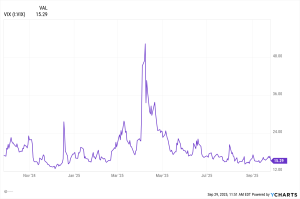
MARKET VOLATILITY
Both realized and implied volatility remained near the lower end of historical ranges this quarter, with measures like the VIX signaling complacency rather than concern.2 Despite occasional spikes around earnings seasons or major data releases, volatility failed to sustain any momentum — except down. These brief spikes were quickly absorbed by the market, which resumed its slow grind higher, giving the impression of investor indifference to just about anything.
EQUITY MARKETS
Leadership rotated slightly, with more cyclical and rate-sensitive sectors, including small- and mid-cap stocks and real estate, participating more than they had earlier in the year. Market breadth, however, remained somewhat narrow, with the largest gains still concentrated in the tech and tech-adjacent areas. The tech heaviness of the market cannot be ignored as the Artificial Intelligence (AI) revolution continues to be the talk of the market, not necessarily due to irrational exuberance, but from the unbelievable levels of capital expenditure and commitment to leading the charge in AI.
In this context, we have maintained a neutral asset allocation stance both in terms of equities to fixed income, and growth-to-value within equities. The past few years have proven more difficult for us to find areas of the market that appear undervalued. However, as tech-heavy sectors continue to drift higher, opportunities are emerging in the seemingly forgotten sectors of the market.
This sentiment, where entire sectors fall out of spotlight, is not new, but in our view, it creates opportunities. This is not a doom-and-gloom situation for growth but rather an opportunity, in our opinion, to better balance risk and reward. Put differently, the bar is raised for growth areas to continue to beat expectations while the margin for error has narrowed.
We also remain of the opinion that volatility tends to mean-revert… in other words, periods of low volatility are followed by a return to higher levels, and vice versa. Markets do not stay calm forever. The timing, however, is impossible to predict, and we believe it is prudent to begin preparing for it rather than wait for it to arrive.
Our neutral positioning gives us the flexibility to react decisively, either by increasing risk if opportunities emerge or getting defensive if more storm clouds arrive.
Our approach is grounded in a couple of key beliefs:
- The current risk/reward dynamic in equities appears balanced rather than overly compelling. That balance largely comes from the fact that some areas of the market are a bit more richly valued.
- We recognize that flexibility is essential in a market like this. Remaining neutral means we’re not overcommitted to any one outcome, which allows us to respond thoughtfully and have the dry powder ready as occasions arise.
FIXED INCOME
Fixed income continues to be a ballast for our portfolios; a source of stability rather than an area where we want to swing for the fences. Our duration, or interest rate sensitivity, remains low as the long end of the curve continues to digest the push and pull between inflation and a softening economy and labor market. It is our opinion that credit spreads are incredibly tight, which to us suggests it doesn’t make sense to take on significant risk in an area that we believe is primarily used to smooth out returns over time.
Importantly, this process is not about making a binary call on market direction. Rather, it’s about acknowledging that market trends change, and that a prudent investor prepares for multiple outcomes.
We are not trying to time the market; instead, we are looking to manage risk in a way that preserves the ability to participate in the upside while protecting portfolios from unforeseen headwinds.
LOOKING AHEAD
Looking forward, we expect the 4th quarter to offer more clarity on whether the low-volatility trend can persist. Key events, including two more FOMC meetings, upcoming inflation and labor market data and the 4th quarter earnings season, will provide insight into the continued health of the consumer and how well companies are performing.3
In summary, Q3 was a quarter characterized not by explosivity but by a calm and steady climb. This environment rewarded patience and penalized overreaction. We maintained a neutral asset allocation and, while welcoming the market’s recent resilience, we remain mindful that periods of low volatility rarely last indefinitely. With that, we continue to look for opportunities to balance risk and reward in a thoughtful and deliberate manner. As always, we will remain flexible and open to changes as they may come with whatever the future holds.
SOURCES:
- Federal Reserve Bank of St. Louis – S&P 500
- Federal Reserve Bank of St. Louis – CBOE Volatility Index (VIX)
- Federal Reserve, FOMC Meeting Calendar 2025 (Board of Governors of the Federal Reserve System).
VIX -The VIX is a theoretical, un-investable benchmark that measures the market’s expectation of future volatility. You cannot purchase the VIX itself like a stock. Instead, you must buy derivatives that track VIX futures, and their value may not perfectly align with the VIX index.
The views expressed are those of the author and Oakworth Asset Management as of the date referenced and are subject to change at any time based on market or other conditions. These views are not intended to be and should not be relied upon as investment advice and are not intended to be a forecast of future events or a guarantee of future results. Past performance is not a guarantee of future performance, and you may not get back the amount invested.