


Due to the Federal government shutdown from October 1 through November 12, 2025, the investing public didn’t have access to a significant amount of pertinent economic data. After all, if the workers who compile things like the Consumer Price Index (CPI) and the Employment Situation report aren’t actually working, we don’t get the information they normally compile.
To be sure, private sector firms like the Institute of Supply Management (ISM), ADP, the Conference Board, the National Federation of Independent Business (NFIB) and others released their data on schedule. However, in a lot of ways, investors were somewhat in the proverbial dark about the true health of the U.S. economy.
While the information from private sources is certainly helpful, the various Federal agencies issue the official data, for all intents and purposes. If the Bureau of Labor Statistics (BLS), the Bureau of Economic Analysis or the Census Bureau doesn’t report it, it effectively didn’t occur for statistical purposes. At least as far as their data sets are concerned.1
So, the markets didn’t know how many jobs the economy was officially adding.
- Inflation? We could only make a stab at it from some of the private sector sources.
- The unemployment rate? Your guess was as good as anyone’s.
- The Consumer Price Index or the PCE Price Index? Who knew for sure?
That made near-term forecasting particularly challenging. To that end, I found myself qualifying most of my comments with something along the lines of: “Due to the government shutdown, we don’t know when we will get the actual data IF we ever get it. However, it appears (or seems) the economy is…”
I suspect I was not alone in being necessarily vague last quarter. While that is usually a best practice, it was an imperative one during much of the fourth quarter of 2025.
But what was the Fed going to do? Would it have enough information to make changes to monetary policy without official data from the BLS, BEA and other Federal sources? After all, investors wanted one — or perhaps two to three — rate cuts in 2025.
Folks just simply had to make do with incomplete information. While you might think that could have been a recipe for disaster, it really wasn’t. Analysts and pundits of all stripes did a pretty good job of deciphering what was happening through a combination of private sector data, proprietary research and, importantly, corporate earnings reports.2
And the consensus? Well, it seems many folks who do what I do for a living felt the economy was still in expansion, but cooling off from a pretty robust third quarter of 2025.3 The labor market appeared to be cooling, and inflation seemed mostly under control. By that, I mean it wasn’t going through the roof, nor was it falling through the floor.
While the data was far from perfect, it was appeared sufficient enough for the Fed to proceed to cut the overnight rate by another 50 basis points (0.50%) during the third quarter. To be sure, it compiles a lot of its own information. Even so, the question I have is:
[Design team: please place the below quoted question inside a red quote box]
“If the Fed can make major changes to monetary policy without having the official economic data from the BLS, BEA, et al., just how important, or accurate, is the official economic data?”
That might have to be a topic of discussion for a future missive.
Now, interestingly and conversely, or so I thought, anecdotal feedback from business owners here in central Alabama was very positive on the economy. In the November 14, 2025, edition of Common Cents, I wrote the following:
Last Thursday, I spoke at a presentation on the economy during a conference for business leaders here in town. After more than 500 public speaking engagements in the past two decades, I suspect I am something of a dependable go-to for organizers looking to fill 30-45 minutes on an agenda.
Regardless, I had fun, as I typically do at such functions. After all, I get to have an opinion in public, which isn’t always the case in private.
Now, one of the things I found particularly fascinating about the event was the overall level of “bullishness” of those in attendance. My co-presenter, the head of the local Federal Reserve branch, was also surprised by it. And for the record, he is a great guy.
Make no bones about it. It seems that business owners and executives in central Alabama are pretty positive about the health of their companies and overall economic conditions. With each glowing survey result the conference leaders put on the screen, the more I wondered what was in the coffee.
Don’t get me wrong. I am not forecasting doom and gloom. No. To me, let’s just say the future looks like a pretty standard ham & cheese on white bread. To the group, it looks like a “croque monsieur,” maybe even a “croque madame.”
In essence, there seemed to be a bit of a disconnect between, well, just about everything. From the lack of government data to the relatively mediocre forecasts of professional analysts to strong corporate earnings reports to weaker consumer confidence, well, it was one of the weirder quarters in recent memory for making predictions (3,4,5).
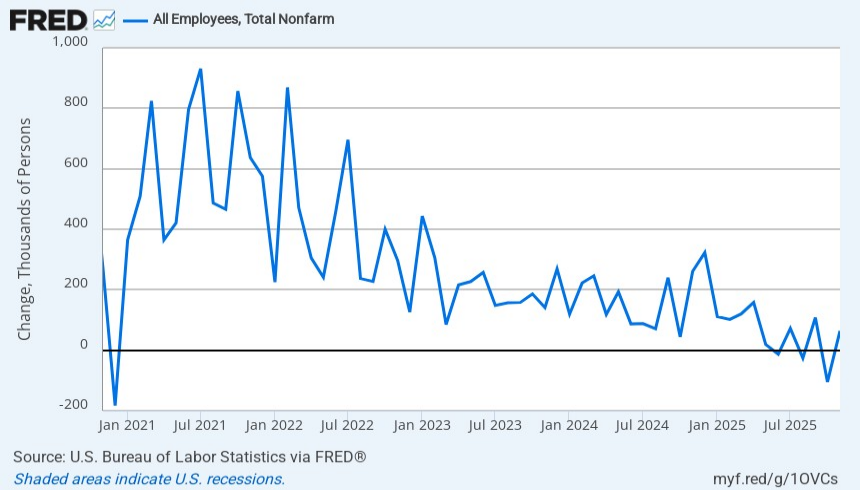
Once the government reopened, it took a little while for the various agencies to get back into a rhythm, if you want to call it that. However, when the data finally arrived, the picture was a little confusing. After all, the Employment Situation reports — in my mind the most important data series — showed a decidedly softer labor market at the end of the year than at the start.6 In fact, one could sensibly argue that such weak job creation might ultimately be a problem in a consumer-driven economy.
A Weakening Labor Market is Rarely Good for the Economy
The Consumer Price Index (CPI) showed some improvement to end the year in aggregate, even if a lot of household necessities were higher than most would like.7 Still, there is no way I was the only person who found the last CPI report for 2025 to be a very confusing read. In fact, one of my first reactions after reading the report was: “If you say so.”
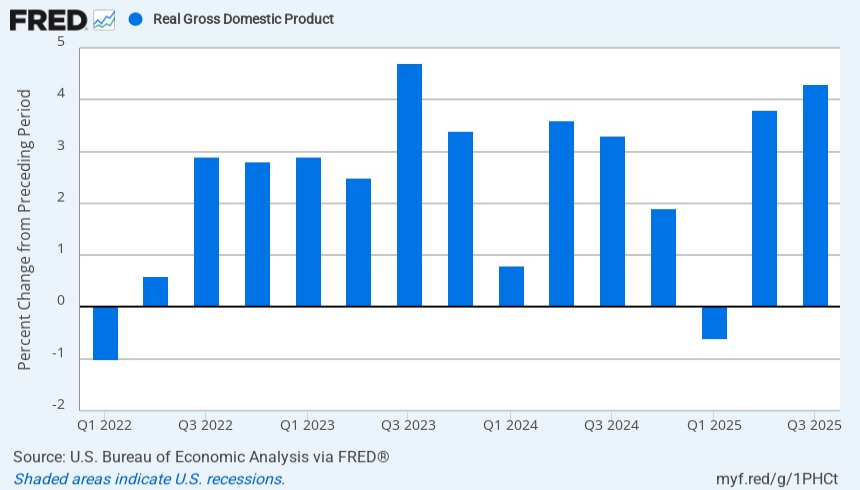
Then, the BEA released the Gross Domestic Product (GDP) report for the third quarter of 2025.8 It was stronger than analysts had forecasted, by roughly a full percentage point. While there was still some noise in the equation due to our improving trade deficit, consumer, business and government demand appeared relatively solid.
To be sure, it is highly doubtful folks will still be discussing this particular report in 100 years. However, suffice it to say, it was better than most people thought it would be.
Better Than Expected GDP Growth…But For How Long?
So, where does that leave us?
Is the economy falling apart like some end-of-year Gallup polls would suggest? Or is it as vibrant as the third quarter GDP report and the bullishness of businesspeople in central Alabama? Are we standing at the precipice? Or are we sitting in the proverbial catbird seat?
If history serves as a guide, and I am supposed to tell you “past performance is not indicative of future results,” the final result is usually in between the two extremes. If the extremes are continued surprising economic strength and economic collapse, the most likely scenario would be somewhat unremarkable economic growth.
Put simply, as we move into 2026, my opinion is that the U.S. economy is neither overwhelming nor underwhelming. It is just whelming, and that is going to have to be good enough for us for now.
In the end, the fourth quarter of 2025 was a confusing one due to the lack of official economic data for much of it, and the wild differences in what ultimately came in. Let’s just hope the fourth quarter of 2026 is a little more normal than this past one.
However, it seems we have been waiting for a “new normal” since the pandemic, and it still hasn’t arrived. Or is the most recent government shutdown proof that it unfortunately has?
SOURCES:
- Brookings – “Is the Credibility of US Government Data at Risk? Why it Matters to Everyone.” (September 2025)
- RSM – “The Rise of Private Label Economic Data.” (October 7, 2025)
- Northmarq – “Economic Commentary: Interpreting the Economy without Government Data.” (October 7, 2025)
- LPL Financial – “Corporate America Cleared a High Bar This Earnings Season.” (November 24, 2025)
- The Conference Board – “U.S. Consumer Confidence Fell Again in December.” (December 23, 2025)
- The Bureau of Labor Statistics Employment Situation – November 2025
- The Bureau of Labor Statistics – Consumer Price Index (December 18, 2025)
- The Bureau of Economic Analysis – Gross Domestic Product, 3rd Quarter 2025 and Corporate Profits (December 23, 2025)
Sources are believed to be reliable but are not guaranteed as to accuracy or completeness.
This material is provided for informational and educational purposes only and reflects the opinions of the Investment Committee as of the date indicated. Statements contained herein that are not historical facts are forward-looking statements and are based on current expectations, estimates, and assumptions. Actual results may differ materially, and views expressed are subject to change without notice. This commentary is not intended as investment advice, does not constitute a recommendation to buy or sell any security, and should not be relied upon as a basis for investment decisions. Past performance is not indicative of future results.