


Every company’s founders dream of ringing the opening bell on a major stock exchange. Becoming publicly traded is often viewed as a milestone that validates years, sometimes decades, of growth and innovation. Taking a successful private company public depends on more than strong earnings, revenue growth, or financial backing. The broader capital markets must also be willing to support new equity issuance. That being said, Initial Public Offerings, or IPOs, tend to arrive in waves. Some years produce hundreds of new public companies with billions or even trillions of dollars of new issuances while others see a desolate IPO market. (1)
Similar to homeowners listing their house when property values are high, business owners and early investors will typically seek to take companies public when investors are willing to pay premium valuations for future growth. That can make IPO activity an interesting indicator of market sentiment. Although a surge in IPOs does not necessarily signal that a market peak is imminent, history shows that periods of elevated IPO activity often correspond with strong equity markets, ample liquidity, and optimistic investor behavior. Simply put, companies generally prefer to sell ownership when buyers are eager to purchase it.
Riding the IPO Waves
Companies decide to go public for several reasons. Raising capital to fund future expansion is a main feature, but it is rarely the only objective. IPOs also provide liquidity for founders, employees, venture capital firms, and private equity investors who may have spent many years waiting for an opportunity to monetize part of their investment.
For investors, the challenge can be determining what the newly offered shares are worth. During periods of economic uncertainty, rising interest rates, or heightened market volatility, investors tend to demand lower valuations. Rather than accepting a discounted price, many companies simply postpone their IPO until market conditions improve. This creates what Wall Street refers to as the “IPO window.” When markets are calm, volatility is low, and investor confidence is improving, that window opens. Investment banks begin marketing deals, institutional investors become more willing buyers, and companies that have been waiting on the sidelines now feel compelled to go public. Conversely, when markets become volatile or recession fears increase, that same window can close almost overnight. The result is an IPO market that tends to be feast or famine instead of maintaining a steady pace.
IPOs and the Market Cycle
Observing IPO issuances over the past several decades reveals a fairly consistent pattern. Following major bear markets, IPO activity usually falls to extremely low levels. Investors become more focused on preserving capital than funding new businesses, making it difficult for companies to achieve attractive valuations. As confidence returns and markets recover, stronger companies begin testing investor demand. Eventually, as stock prices continue climbing and economic conditions improve, the number of IPOs accelerates. During the later stages of bull markets, companies that may not have considered going public earlier often decide to seize the opportunity.
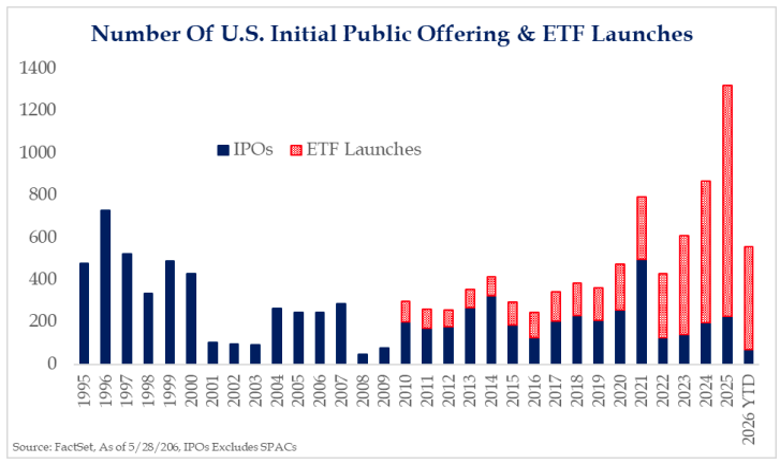
The late 1990s technology boom produced one of the largest IPO waves on record as internet companies rushed to public markets leading up to the dot-com bubble bursting in 2000. (2) A similar pattern emerged leading into the Financial Crisis, with IPO issuance strengthening during 2006 and 2007 before markets capitulated. (2) More recently, the combination of historically low interest rates, fiscal stimulus, and abundant liquidity following the COVID-19 pandemic fueled another record-setting IPO market during 2020 and 2021. (3) Traditional IPOs were joined by a surge in Special Purpose Acquisition Companies (SPACs), providing investors access to hundreds of newly public businesses in a short period of time.(4)
As inflation accelerated and the Federal Reserve aggressively increased interest rates throughout 2022, stock valuations compressed, volatility increased, and IPO activity decreased dramatically.(3) Companies that may have planned to go public chose patience over accepting significantly lower valuations.
What IPO Activity Can Tell Investors
Investors often ask whether a surge in IPO activity means the stock market is approaching a peak. And while the market usually sees a surge in IPO activity leading up to corrections or bear markets, the indication is more of a correlation than causation. High IPO volume is better viewed as a reflection of investor optimism than as a market timing indicator. Strong markets create favorable conditions for companies to issue stock, but those favorable conditions can persist for months or even years before eventually reversing.
Think of IPO activity as a market thermometer rather than a market clock.
When IPO issuance is elevated, it often suggests investors have become increasingly comfortable taking risk. Valuations are generally higher, credit markets are functioning well, and capital is readily available. Those conditions are characteristic of healthy bull markets, but they can also encourage excessive optimism if investors begin overlooking business fundamentals in pursuit of growth. That’s where investors should be mindful of increasing risk, particularly if market participants begin overlooking business fundamentals. Not every IPO wave ends in disappointment, and not every market correction follows an IPO boom. However, periods of unusually high issuance have historically occurred alongside elevated investor confidence.
Why Large IPOs Matter
Most IPOs receive little attention outside Wall Street, but every so often a company prepares to go public that captures the attention of the entire investment community. Large technology companies are particularly influential because of their size and potential inclusion in major stock market indices. When a multi-billion-dollar company, or more recently – a trillion-dollar company, begins trading publicly, the effects can be felt well beyond the company’s own shareholders. Institutional investors may redirect capital toward the offering, exchange-traded funds may choose to increase their holdings as assets grow or portfolio allocations change. This is one reason investors closely monitor the IPO pipeline. Large offerings can temporarily absorb market liquidity while also creating additional demand if index funds must purchase the stock after it becomes eligible for inclusion.
How Passive Investing Has Changed the IPO Landscape
The rise of passive investing has also changed the importance of IPOs. Decades ago, active portfolio managers largely determined how much demand a newly public company would receive. Today, trillions of dollars in assets track market indices, meaning index eligibility has become almost as important as the IPO itself.(5) Once a company satisfies the requirements for inclusion in a major index, passive investment vehicles are generally required to purchase shares regardless of valuation or market sentiment. That mechanical buying can provide meaningful support to a newly public stock while also increasing trading volume. Because of the growing influence of passive investing, market participants have increasingly debated whether certain high-profile companies should receive expedited index consideration following their IPO. While individual circumstances vary, these discussions highlight how significantly today’s market structure differs from previous decades.
What Today’s IPO Environment Suggests
Compared to the nearly frozen IPO market of 2022 and much of 2023, today’s environment appears more eager to digest increased offerings. In our view, given recent IPO volume – both in terms of quantity of offerings and market value being absorbed by the market – this sentiment gauge appears somewhat elevated relative to longer-term (3) averages. To be sure, today’s environment does not fully resemble the overexuberance seen during the 2000 tech bubble or the 2021 SPAC boom as investors have generally become more selective.
Additionally, fund companies have dramatically expanded the number of exchange-traded funds (ETFs) they offer. When combining the number of ETFs with company IPOs, the search for “new” is not a difficult game of hide-and-seek. (5)
ETF launches may influence market liquidity and capital flows in certain market segments, although the magnitude of those effects remains subject to ongoing debate among market participants. The extent of those effects, however, remains the subject of ongoing debate among market participants. Add to that nearly 15% of ETFs that launched over the past five years are leveraged, meaning they use financial leverage to seek a specified multiple (or inverse multiple) of the daily performance of an underlying benchmark. Essentially, the fund takes on additional risk in search of higher returns. That 15% introduction of leveraged funds over the past five years is 3x more than the roughly 5% between 2015-2019. (6)
The Closing Bell
IPOs generate excitement because they represent new opportunities for investors to participate in growing businesses. A robust IPO market generally reflects confidence in the economy, enthusiasm in capital markets, and investors willing to assume additional risk. IPO activity serves as another piece of the broader investment puzzle. Markets constantly provide clues about investor psychology with credit spreads, volatility, corporate earnings, and interest rates all helping tell the story. Watching when companies decide to sell ownership of their businesses can often reveal just as much about investor demand as it does about the companies themselves. The opening bell may belong to one company, but, when IPOs arrive in waves, the investors’ willingness to answer it can tell us a great deal about the market as a whole.Top of FormBottom of Form
- Bloomberg – Warburg CEO Calls IPO Market ‘Broken’ Even Amid Giant Offerings. June 6, 2026
- Warrington College of Business – IPO Data. Accessed July 1, 2026.
- Ernst and Young – 2025 US IPO Activity Fuels Confidence for 2026. January 28, 2026.
- SPAC Research.com
- The Investment Company Institute – The ICI’s Fact Book. Accessed July 1, 2026.
- ETF.com – Leveraged ETF Launches Leap as Investors Embrace Risk. July 30, 2025.
Advisory services, including investment management and financial planning, are offered through Oakworth Asset Management LLC, an SEC-registered investment adviser and a wholly owned subsidiary of Oakworth Capital Bank, Member FDIC and Equal Housing Lender. Registration with the U.S. Securities and Exchange Commission does not imply a certain level of skill or training. Investment products and services offered through Oakworth Asset Management LLC are not deposits, are not FDIC insured, are not bank guaranteed, may lose value, and are not insured by any federal or state government agency. Due to the ownership relationship between Oakworth Capital Bank and Oakworth Asset Management LLC, conflicts of interest may exist to the extent that either entity recommends the services of the other. Additional information regarding Oakworth Asset Management LLC, including its services, fees, and conflicts of interest, is available in the firm’s Form ADV at www.adviserinfo.sec.gov.
This communication is provided for informational and educational purposes only and should not be construed as investment, legal, tax, accounting, or other professional advice. The views and opinions expressed are those of the author(s) as of the publication date and are subject to change without notice.
The information presented is general in nature and is not intended to address the specific objectives, financial situation, or particular needs of any individual investor, account, or client relationship.
Nothing contained herein constitutes a recommendation to buy, sell, or hold any security, investment product, or investment strategy, nor should any information presented be relied upon as the basis for making an investment decision. References to specific securities, companies, industries, sectors, market indices, economic conditions, political developments, or geopolitical events are provided solely for informational and illustrative purposes and should not be interpreted as investment recommendations, endorsements, or predictions of future investment results. Investment strategies discussed may not be suitable for all investors. Individuals should consult their own financial, legal, tax, accounting, and other professional advisers before making any financial decisions.
This communication contains general information that may not be suitable for every investor and may be based on assumptions, estimates, opinions, and forward-looking statements that are subject to change. Actual results may differ materially from those expressed or implied, and no assurance can be given that any expectations, forecasts, or opinions discussed herein will be realized.
Investing involves risk, including the possible loss of principal. Past performance is not indicative of future results and should not be relied upon as a predictor of future performance. There is no guarantee that any investment strategy will achieve its objectives or avoid losses.
Any references to market indices are provided for illustrative purposes only. It is not possible to invest directly in an index. Index performance reflects the reinvestment of dividends, where applicable, but does not reflect the deduction of fees, expenses, or transaction costs, which would reduce returns. It should not be assumed that any client account will achieve returns comparable to any index discussed.
Information contained herein may be obtained from third-party sources believed to be reliable; however, Oakworth Asset Management LLC and Oakworth Capital Bank do not warrant or guarantee the accuracy, completeness, or timeliness of such information. References or links to third-party content are provided solely as a convenience and do not constitute an endorsement of any third-party views, products, or services.
Oakworth Asset Management LLC does not provide legal or tax advice. Individuals should consult their attorney, accountant, or tax adviser regarding their specific circumstances.